Raja Ravi Varma A tribute by his great-great-grandson, Dr. Vishnu Ravi

The artist who brought
India's gods to life And put them on a million walls

Raja Ravi Varma fused the realism of European salons with the iconography of the Puranas, and then, in a press at Lonavla, democratized art for the Indian masses.

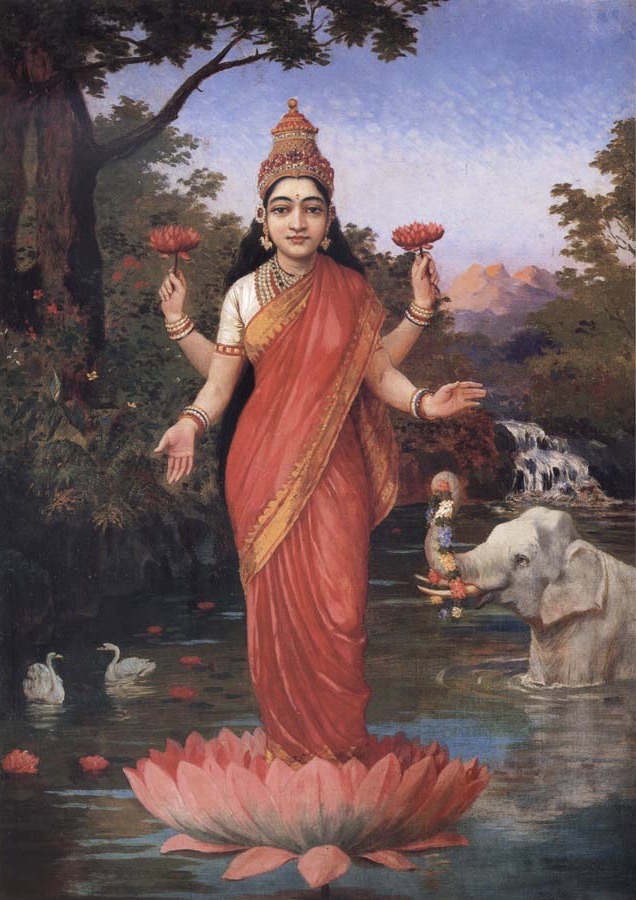
Shakuntala, c. 1870 Damayanti and the Royal Swan, 1899 Yashoda with Krishna Lakshmi
Shakuntala · c. 1870
Oil on canvas · Sri Chitra Art Gallery, Trivandrum
Damayanti & the Royal Swan · 1899
Oil on canvas · Sri Jayachama Rajendra Art Gallery, Mysore
Yashoda with Krishna · c. 1899
Oil on canvas · Private collection
Lakshmi · c. 1894
Oleograph · Ravi Varma Press, Lonavla
Shakuntala Damayanti & the Swan Galaxy of Musicians Lakshmi Saraswati The Milkmaid Jatayu Vadham There Comes Papa Yashoda & Krishna Mohini on a Swing

In 1873, an artist from a small Kerala palace sent four canvases to Vienna and won a prize. He was twenty-five. Within two decades the gods of the subcontinent looked the way he said they looked: poised, fleshly, lit from a window in a palace that didn't quite exist. Lakshmi standing on her lotus. Saraswati at her veena. Krishna, in the soft round of his foster-mother's lap.

Raja Ravi Varma made oil painting speak Sanskrit. He commanded the academic naturalism of Theodore Jensen and the dramatic pathos of late-Victorian salon painting, and made them serve the Mahabharata. And then, knowing his true audience was the Indian people themselves, he opened a lithographic press and put his goddesses within reach of every household.

"In my childhood, when Ravi Varma's age arrived in Bengal, reproductions of European paintings on the walls were promptly replaced with oleographs of his works." , Rabindranath Tagore
"There is hardly a Hindu home in this country without a print of one or another of Ravi Varma's deities." , Bal Gangadhar Tilak
"Ravi Varma was the first artist to give the Hindu pantheon a face the whole subcontinent could agree on." , Partha Mitter, art historian

What follows are six chapters: a biography, a gallery, a close reading of Shakuntala, a portrait of the Press, an essay on style, and a survey of his long shadow on Indian cinema and visual culture.

1848Born, Kilimanoor
1873Vienna prize · age 25
1894Press founded · Bombay
1906Died, Kilimanoor
"
Ravi Varma is the indisputable father figure of modern Indian art.
, Geeta Kapur, art historian
Wander the Site

Six chapters in his life & afterlife

Self-portrait of Raja Ravi Varma i

The Life

From a feudal palace in Travancore to the durbar halls of Baroda, the biography, told as a timeline.

Read the biography
Damayanti and the royal swan ii

The Gallery

A curated selection of his canvases, framed and captioned. Click any to look closer.

Enter the gallery
Shakuntala feigns plucking a thorn from her foot iii

Shakuntala

A scrolling, close-reading of his most famous painting, the thorn, the glance, the lover beyond the frame.

Look closer
Lakshmi, the press oleograph iv

The Press

How a German lithography machine and a brother named Raja put the gods on every wall in India.

Visit Lonavla
Yashoda adorning Krishna v

Style & Legacy

East meets West, on canvas. And then on every poster, calendar, and matinee screen for a century after.

Trace the influence
Jatayu Vadha, 1906, his last canvas vi

A Timeline

1848 to 1906, year by year, patrons, prizes, paintings, the press, and the long quiet at Kilimanoor.

See the years
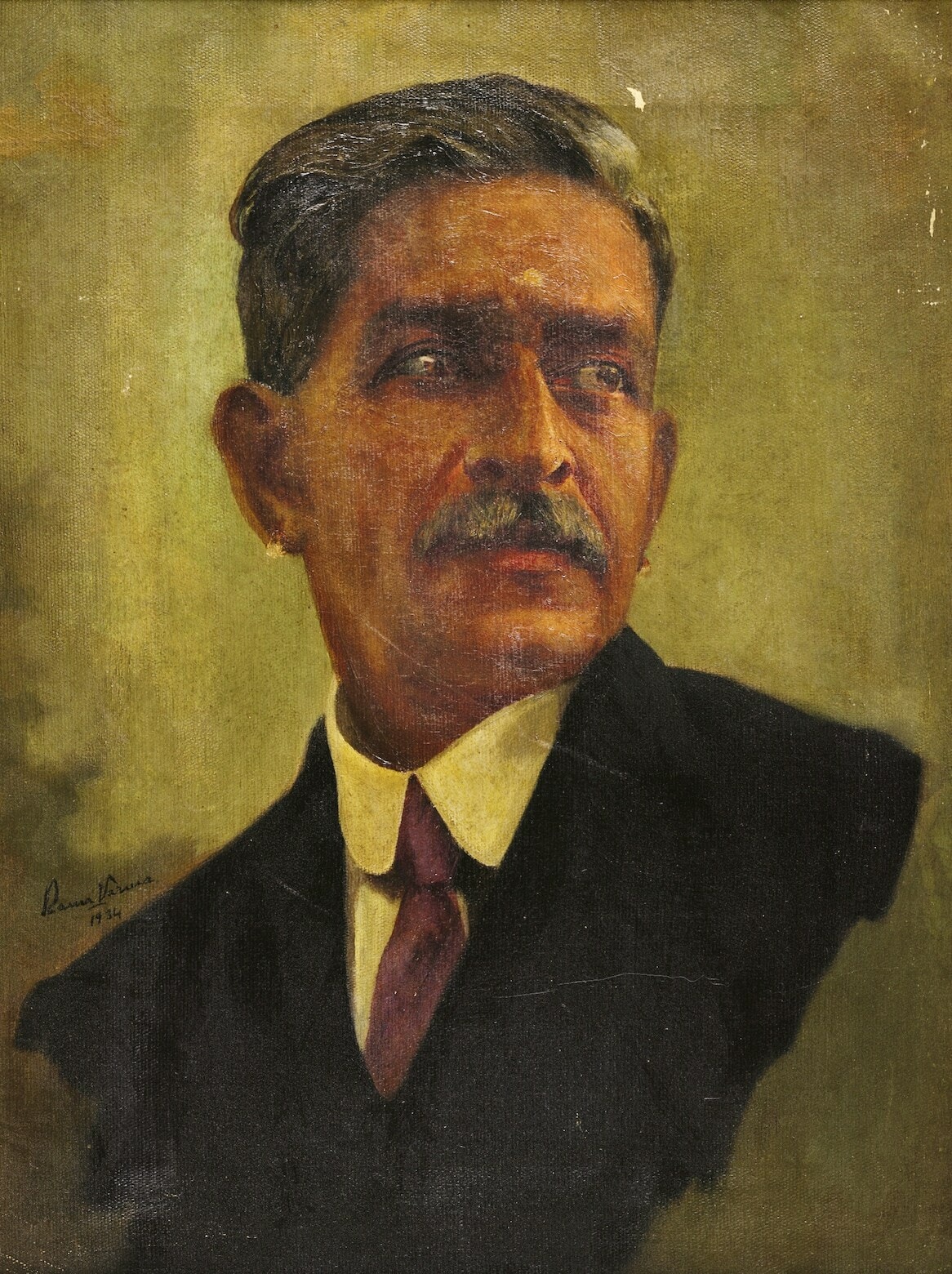
Rama Varma, the Artist Thampuran of Mavelikara
Rama Varma · b. 1879
The Artist Thampuran of Mavelikara
The line continues

His son, Rama Varma
b. 1879 · Artist Thampuran of Mavelikara

The younger son of Raja Ravi Varma, Rama Varma, known across Kerala as the Artist Thampuran, inherited his father's hand and carried his discipline forward into the next century. From 1897 to 1903 he studied at the Sir J. J. School of Art in Bombay, then returned home to Mavelikara, set up his own studio, and worked alongside his father until Ravi Varma's death in 1906.

He painted portraits, history scenes, and figures from legend, among them Ajavilapam, a portrait of Sir Winston Churchill, a study of Rana Pratap, and, in 1948, a portrait of his father. Many of his canvases carry the unmistakable proportions, the cast of light, the fall of cloth that he had learned at his father's side.

"He left behind an impressive legacy as an artist, teacher, and social activist, and was the driving force behind the establishment of the Raja Ravi Varma College of Fine Arts in Mavelikara."

The school he built, known locally as the Painting School, welcomed students from every section of Keralite society. Rama Varma married Gowri Kunjamma, sister of Dewan P. G. N. Unnithan, and had ten children. The line he carried forward runs, four generations on, to the descendant who has gathered this site.

1879 Born · younger son of
Raja Ravi Varma
189703 Sir J. J. School of Art
Bombay
Mavelikara Founded the Raja Ravi Varma
College of Fine Arts
A descendant's note

Four generations on, the line that ran from a Kilimanoor palace to a Mavelikara studio still finds its way to a desk under a window. This site is one descendant's small offering, gathering a great-great-grandfather's life into a single place so the next generation might know him.

Dr. Vishnu Ravi · 2026