Chapter IV · The Press

Lakshmi for every home

In 1894 Ravi Varma opened a German-machined lithographic press in a Bombay suburb. By 1900, his oleographs had become a household fixture on middle-class walls across India. He was, in effect, the artist who first gave the subcontinent its own visual language at scale.

1894Press founded · Ghatkopar
1899Moved to Lonavla
1901Sold to Schleicher
1972Factory destroyed by fire
Lakshmi oleograph
Two goddesses, on every wall

The gods on every wall

The press democratized art. Ravi Varma was the first to put great art on the wall of an ordinary Indian home: his oleographs brought a goddess into every household, however modest. Within a decade of the press opening, his Lakshmi and Saraswati had become a household fixture across the subcontinent.

For many Indians, the prints were the first time they had seen the goddess at all.

Saraswati oleograph
i.The advice

"Make them yourself."

By the early 1890s, Ravi Varma's mythological canvases were enormously popular in Indian princely circles, but each canvas was one canvas. A single Lakshmi for the Maharaja of Mysore. A single Krishna for Baroda. Reproductions of his work, at any kind of scale, did not yet exist.

It was T. Madhava Rao, the former Dewan of Travancore and one of the great administrative minds of nineteenth-century India, who suggested Ravi Varma open his own press. The artist accepted the advice in 1894.

From the Dewan

"You should not give your gods only to those who can pay for canvas. The country wants them on the wall."

ii.The machinery

A German press in a Bombay suburb

The first press was at Ghatkopar, then a quiet eastern suburb of Bombay. By 1899 the equipment had been moved to Malavli, near Lonavla, where the air was drier and the Western-Ghats elevation made the printing climate more reliable. The chief technician was Fritz Schleicher, recruited from Germany, Ravi Varma's brother Raja Raja Varma managed the business side.

The presses produced oleographs, chromolithographs printed in oil-based inks to mimic the texture of an oil painting. A typical Ravi Varma oleograph was printed from twelve to fifteen separate stones, each carrying a single colour, registered carefully against the others. The technical achievement was considerable; the result, on cheap paper, was startling.

How an oleograph was made

01

Painting

Ravi Varma paints the original in oil on canvas, usually 4×3 feet or smaller. The composition has to read at print scale.

02

Separation

Lithographers at the press separate the canvas into 12–15 colour layers, flesh, sky, gold border, the rose-pink of a sari.

03

Stones

Each layer is drawn by hand on a polished limestone block, heavy, fragile, perishable. The stone is the negative.

04

Print

Sheet by sheet, the paper is pulled through the press for each colour, registered to a hairline. And the goddess could come home with you.

iii.A wider life

From one artist's hand to a nation's walls

In 1901 Ravi Varma transferred the press to Fritz Schleicher, his long-serving German technician. Under Schleicher the press continued issuing prints under Ravi Varma's name, while expanding into the wider commercial work of a new century, calendars, advertisements, textile-mill prints. The press had become an institution; the iconography it carried was already, indelibly, his.

By then the work itself was already done. The iconography had spread; the pictures were on the walls. What began as one studio's experiment in mechanical reproduction was, within a decade, the visual common language of an emerging nation.

A footnote

In 1972 a fire destroyed the factory at Lonavla, including most of the original lithographic stones and many irreplaceable proofs. What survives of his oleographic work is, mostly, what was already on people's walls.
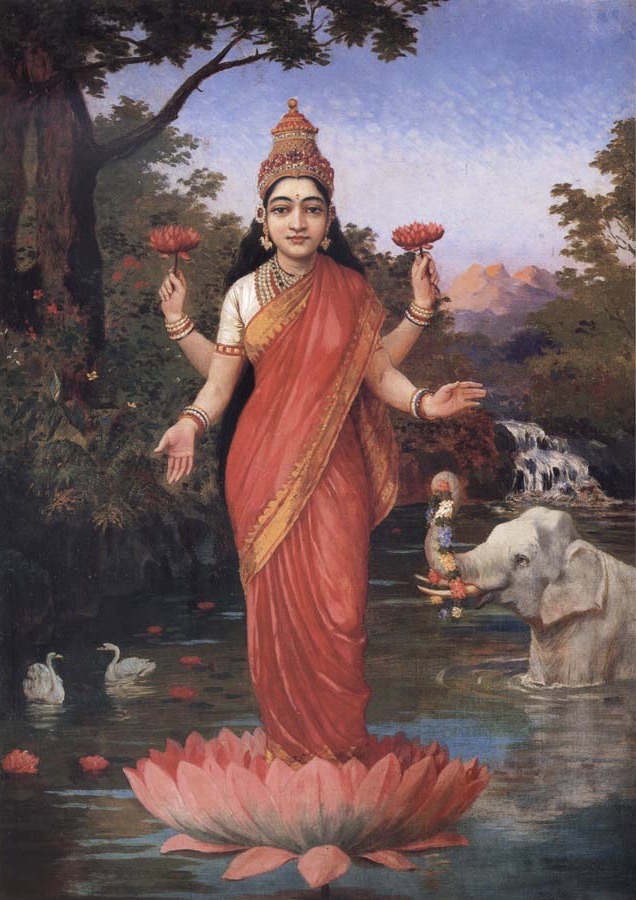
A wall of oleographs

What Indians saw, framed in their parlours

Lakshmi
Saraswati
Damayanti
Shakuntala
Jatayu
Yashoda Krishna
Continue

Style, technique, and a long shadow

On to the legacy →